In This Article
- Do introverts and extroverts actually use AI differently, and does it matter?
- What behavioral patterns in your AI conversations might reveal about your susceptibility to influence?
- How can AI mislead you without ever technically lying to you?
- What is the difference between using AI and surrendering your judgment to it?
- How do you build a relationship with AI that protects your ability to think for yourself?
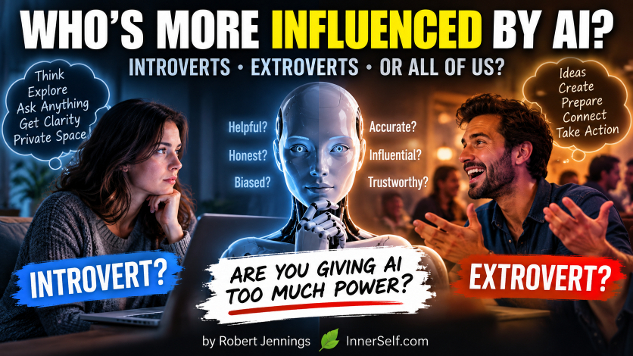
There is a question worth sitting with before you type your next prompt. Can an AI figure out what kind of person you are just from watching how you talk to it? Not from what you ask, necessarily, but from how you ask it. Whether you push back. Whether you accept the first answer. Whether you keep rephrasing until you get the answer you already wanted. The personality question is interesting. The influence question underneath it is considerably more important.
Introverts, Extroverts, and the Machine Between Them
Introversion and extroversion are not diagnoses. They are tendencies, points on a spectrum that describe where people tend to draw energy from and how they prefer to process experience. Research in technology-mediated communication suggests that introverts often take to text-based interaction more readily than face-to-face conversation, finding it a lower-stakes environment for working through ideas. An introvert might use AI as a kind of private thinking room: a place where a thought goes in rough and comes out refined before it ever meets another human being.
An extrovert's tendency runs the other direction. Initial thought meets interaction, feedback shapes the idea, and the refinement happens in the exchange itself. Neither pattern is superior. But they produce different kinds of AI conversations, and different conversations leave different kinds of fingerprints. Across hundreds of interactions, those fingerprints start to form a picture. Not a definitive psychological profile, but a behavioral pattern. And behavioral patterns are exactly what AI systems are built to recognize.
Here is where the personality question gets eclipsed by something bigger. Maybe AI can make reasonable inferences about introversion or extroversion from the way someone converses. But personality might not be the most consequential thing those conversations reveal. The more important signal may be how much authority a person gives the machine. How often they challenge it. How readily they accept what it says. In short, how susceptible they are to being shaped by it.
AI as a Mirror That Learns Your Reflection
A single conversation tells an AI system very little about you. But patterns across many conversations are a different matter entirely. Do you challenge the answers you receive, or do you move on? Do you ask for evidence, or do you treat a confident-sounding response as evidence enough? Do you ask the same question multiple ways until you get the conclusion you were hoping for? Do you treat the AI as a tool, a teacher, a companion, or something closer to an oracle?
These behaviors, repeated across time, create a behavioral signature. Researchers studying human-AI interaction have found that people vary substantially in what is called automation bias, the tendency to favor machine-generated recommendations over their own judgment even when they have good reason to be skeptical. People also vary in how much they anthropomorphize conversational AI, attributing to it something like intention, warmth, or trustworthiness that the system does not actually possess. Both tendencies shape how a person receives what the machine says. And both can be inferred, at least probabilistically, from how someone behaves during a conversation.
None of this means any AI system is actively profiling you for influence purposes. The point is subtler and in some ways more unsettling. You may be training yourself through your own habits of use.
Who Is Actually Most Susceptible to AI Influence
Introversion versus extroversion probably isn't the most important variable in determining who AI influences most. The stronger factors look like this in ordinary life. A person who relies on AI for decisions they don't understand well is more susceptible than someone with deep subject knowledge in that area. Someone who already distrusts their own judgment is more susceptible than someone who habitually questions external sources. A person who is lonely or emotionally vulnerable and begins to experience an AI as a companion may start to confuse familiarity with trustworthiness. Someone who is uncertain about what they believe is more likely to accept whatever framing the AI happens to present.

Confirmation bias plays a central role. It always has. Human beings have always been drawn to information that confirms what they already suspect, and they have always been remarkably creative about finding it. What AI changes is the speed and efficiency of that process. Historically, a person seeking confirmation would look for the right newspaper, the right preacher, the right television commentator, the right community. That took effort and time. With conversational AI, you can potentially manufacture agreement in seconds, simply by rephrasing your question until the system produces the framing you wanted. You no longer have to search for someone who agrees with you. You can construct the agreement yourself, and mistake it for independent confirmation.
AI Does Not Have to Lie to Mislead You
This point deserves its own room because people often conflate misleading AI output with deliberate deception. An AI system does not need to intend to mislead you in order to mislead you. The mechanisms are more mundane and more numerous than that.
Training data contains human biases and errors, and the model learns from both. Information has a timestamp, and models are trained on data up to a cutoff date, after which the world keeps changing and the model does not. Hallucination, where a language model generates plausible-sounding but factually incorrect information, is a documented and persistent problem. Poorly framed questions produce answers shaped by the framing rather than by the underlying reality. Missing context produces overgeneralized conclusions. And conversational AI is fundamentally designed to generate responses that are useful and plausible, which is not at all the same thing as responses that are accurate.
The critical point is this: confidence is not evidence. An incorrect AI answer can be delivered in exactly the same measured, authoritative tone as a correct one. There is no tremor in the voice, no hesitation, no visible uncertainty to tip you off. A wrong answer about medication interactions sounds just like a right one. A wrong answer about history, law, or science carries the same surface texture as a correct answer. Your own critical judgment is the only thing that creates a meaningful difference between them.
How to Tell Whether AI Is Actually on the Level
There are practical tests anyone can run. Before accepting a consequential AI conclusion, try asking the system directly what it knows versus what it is inferring. Ask what it is uncertain about. Ask what evidence supports the conclusion. Ask what the strongest evidence against that conclusion would look like. Ask what would cause it to reach a different answer.
The most useful adversarial move goes something like this: assume your previous conclusion is wrong. Build the strongest evidence-based case against it, identify anything you may have overstated, and explain what evidence would change your conclusion. This prompt works because it breaks the natural tendency of conversational AI to be agreeable and to build on prior framing. It forces the conversation toward falsification rather than confirmation.
This is not a clever AI trick. It is the scientific method applied to a conversation. Good reasoning does not merely accumulate evidence that supports an idea. It actively searches for evidence capable of disproving it. Applying that standard to AI output is not optional for anyone who wants to use the tool without being used by it.
Three Ways People Relate to AI and Why One Is Safer Than the Others
Most people fall into one of three relationships with AI. The first is AI as authority. The user asks what is true, or what they should do, and accepts the answer. This relationship carries the greatest risk of surrendering independent judgment. The machine becomes the final word rather than one input among many.
The second is AI as companion. The user talks through problems, emotions, decisions, and uncertainties. This can be genuinely valuable. But it carries a specific danger: emotional familiarity can quietly become confused with reliability. A system that feels warm and attentive can start to feel trustworthy in ways that have nothing to do with whether its factual output is accurate. Loneliness amplifies this risk considerably, and research on conversational AI use has found that socially isolated users are more likely to anthropomorphize AI systems and attribute human-like judgment to them.
The third is AI as intellectual sparring partner. In this relationship, the user expects the machine to be wrong sometimes. They demand evidence. They request counterarguments. They test assumptions and independently verify consequential claims. The goal is not to get the AI to think for you. The goal is to use the AI to make your own thinking harder to fool. This third model does not eliminate AI error. It eliminates your uncritical acceptance of it.
The Person Who Uses AI All Day May Be Freer Than You Think
There is a comfortable assumption that the people most influenced by AI must be the people who use it most. This turns out to be the wrong frame entirely. Someone using AI eight hours a day while constantly challenging it, demanding evidence, checking sources, and requesting counterarguments may retain more intellectual independence than someone who uses it for ten minutes and spends those ten minutes asking what they should believe, what they should buy, and who is right.
Frequency of use is not the same thing as dependence. The meaningful distinction runs between use, reliance, dependence, and authority. A hammer used all day remains a tool. A hammer treated as a master carpenter is a different relationship entirely. The question is not how long you spend with AI. The question is who is running the conversation.
This Shift Has Happened Before
Every major information technology has changed not only what people knew but who they trusted to tell them what was true. Priests held that authority for centuries. Kings and governments claimed it. Then came newspapers, radio, television, advertising, search engines, and social media algorithms. Each shift transferred some portion of epistemic authority, the power to establish what counts as real, from one institution to another.
AI represents another such shift. But it is qualitatively different from all the previous ones. Television spoke to everyone in the same voice. A newspaper said the same thing to every reader. AI talks back. It adapts. It responds to the individual, in real time, in a conversational register that mimics the structure of human exchange. No previous mass medium did that. The psychological intimacy of the interaction is historically novel, and the habits of trust people bring to human conversation do not automatically translate safely to a machine that has learned to sound like one.
Human civilization spent centuries building institutions designed to establish knowledge through evidence, argument, peer review, journalism, courts, and public debate. These institutions are imperfect. Some are badly broken. But they were built precisely because unaided human judgment was shown, repeatedly, to be unreliable under pressure. What happens when people begin replacing those processes with the phrase I asked the AI? The danger is not a superintelligence deciding to control humanity. The nearer danger is humans growing comfortable enough with AI that they quietly stop demanding evidence at all.
The Discipline That Makes AI Worth Using
Return, for a moment, to the original question. Perhaps AI can make reasonable inferences about personality from how we interact with it. Tendencies in how we seek information, how we respond to uncertainty, how we frame our questions. These are behavioral signals, not certainties, but signals nonetheless.
But the more important thing our conversations may reveal is whether we have retained the habit of independent judgment. Not whether we use AI. Not how often. Whether we have maintained the discipline of treating its output as a starting point for our own thinking rather than the end of it.
The most useful principle to carry forward is this: do not ask whether you can trust AI. Develop a way of using AI that does not require trust. Demand evidence. Request the counterargument. Assume the answer might be wrong and look for where it breaks. Use the machine to sharpen your own reasoning rather than to replace it. The best relationship with artificial intelligence is neither obedience nor rejection. It is disciplined skepticism. Use the machine. Question the machine. Keep the final act of judgment human.
About the Author
 Robert Jennings is the co-publisher of InnerSelf.com, a platform dedicated to empowering individuals and fostering a more connected, equitable world. A veteran of the U.S. Marine Corps and the U.S. Army, Robert draws on diverse life experience, from real estate and construction to building InnerSelf.com with his wife, Marie T. Russell, bringing a practical, grounded perspective to life's challenges. InnerSelf grew from InnerSelf Magazine, founded by Marie T. Russell in 1985, which became InnerSelf.com in 1996. Decades later, InnerSelf continues to inspire clarity and empowerment.
This article is licensed under a Creative Commons Attribution-NonCommercial-NoDerivatives 4.0 License. You may share it with attribution to Robert Jennings, InnerSelf.com, and a link back to the original article at InnerSelf.com. Commercial use and derivative works are not permitted without permission.
Recommended Books
Thinking, Fast and Slow by Daniel Kahneman — A landmark examination of the two systems of human thought that explains why we are vulnerable to cognitive shortcuts, biases, and the seductive confidence of authoritative-sounding sources.
The Alignment Problem by Brian Christian — A rigorous and accessible investigation into how AI systems learn human values imperfectly, why that produces unreliable output, and what researchers are doing to address it.
You Are Not a Gadget by Jaron Lanier — A pioneering computer scientist argues that digital systems shape human thought and culture in ways users rarely notice, making the case for defending individual judgment against algorithmic influence.
Article Recap
The real risk of artificial intelligence is not how often you use it but whether you have surrendered your critical judgment to it, treating AI output as authority rather than as one input to be tested, challenged, and independently verified. Understanding AI influence, automation bias, and confirmation bias in human-AI interaction gives you the practical tools to use conversational AI without being quietly shaped by it. Disciplined skepticism toward AI, demanding evidence, requesting counterarguments, and keeping final judgment human, is the habit that separates productive AI use from intellectual dependence.
#AIInfluence #CriticalThinkingAndAI #TrustingArtificialIntelligence #AIBias #AutomationBias #ConfirmationBias #AIAndPersonality #AIDecisionMaking #IntellectualIndependence #AISkepticism