Recent research highlights the origins of callous-unemotional (CU) traits in children, linking them to fearlessness, social connection, and imitation behaviors. These traits can lead to antisocial behaviors, emphasizing the importance of nurturing positive social interactions and avoiding harsh parenting to foster emotional development.
In This Article
- What are the implications of callous-unemotional traits?
- What mechanisms contribute to the development of CU traits?
- How do fearlessness and imitation influence CU traits?
- What practical strategies can parents use to support emotional development?
- What are the risks of harsh parenting in relation to CU traits?
Two new papers may provide new insight into a set of behaviors known as callous-unemotional traits.
The researchers found that young children who exhibited less fear and desire for social connection and who engaged less frequently in a copycat behavior called arbitrary imitation developed more callous-unemotional (CU) traits, which are known to lead to antisocial behavior later.
A link between antisocial or aggressive behavior and callous-unemotional (CU) traits—characterized by lack of empathy, guilt, and reduced sensitivity to others’ emotions—is already well known. Previous research has revealed that children with these characteristics are more likely to develop severe, persistent antisocial behavior, often expressed through violence and hostility.
Practically speaking, this translates to a child who is “less compassionate, doesn’t care about breaking the rules, doesn’t change a behavior when they’re told, ‘If you do X, this bad thing will happen,'” says Rebecca Waller, an assistant professor in the psychology department at the University of Pennsylvania and director of the EDEN Lab. “They’re also more likely to be aggressive to get what they want because they don’t fear the consequences.”
What’s less understood are the mechanisms and processes that give rise to CU traits, knowledge with important implications for the development and implementation of effective interventions. Waller and Wagner looked at two ideas: The first focuses on fear and social belonging, also known as affiliation; the second is related to imitation.
Fear, social rewards, and callous-unemotional traits
To test their first theory, the researchers used data from the Boston University Twin Project. During two two-hour lab visits, at age three and again at age five, children played out several scenarios, like offering a parent “candy” from a canister that actually contained a stuffed snake, popping bubbles, or separating different-colored beads into piles.

Analysis of the children’s behaviors showed that less fearful children who cared less about social connections at the first visit were more likely to develop callous-unemotional traits by the second.
“Fearlessness on its own is not the only ingredient,” Waller says. “These children also don’t feel, to the same degree, that inherent motivation and reward from having positive social bonding with others.”
The researchers also found that harsh parenting—which includes tactics like yelling and spanking—intensified the fearlessness and strengthened the link with later CU traits.
“Parents have a set of tools,” says Nicholas Wagner, an assistant professor at Boston University and director of the Biobehavioral and Social-Emotional Development Lab. “If kids are fearless, including toward the potential for punishment, the likelihood that harsh parenting will exacerbate risk increases. That fits into the model that clinicians understand already. It takes two to tango; what kids bring to the table mixes with what they’re experiencing in the environment.”
These findings appear in Psychological Medicine.
Imitation and connection
The study in the Journal of Child Psychology and Psychiatry, which researchers conducted with a different set of two- and three-year-old Twin Study participants, compared instrumental and arbitrary imitation. The former means copying behaviors that serve a function, often done to learn a skill. The latter means following another’s actions for no purpose than to exhibit the desire for a social connection.
“Arbitrary imitation is intended to build bonds,” Wagner says, “to show another person that you’re in their group, that you accept their ways, that you can and will do what they’re doing.”
For this work, the team built a pair of experiments. In the first, children had to free a stuffed bird from a hard-to-open cage. An adult showed them how, interspersing necessary instruction with unneeded vocalizations like “Look, it’s a birdy!” During a second task, children had to use a stick to liberate a cracker stuck in the middle of a clear tube. Again, an adult modeled the steps, mixing essential and arbitrary directions.
In both cases, researchers watched and coded which behaviors the children repeated and which they ignored.
They found that the two-year-olds who engaged in less arbitrary imitation overall—in other words, those who ignored more of the unneeded actions—were at greater risk for developing CU traits later.
“This says to us that these children are less motivated to make connections with other kids or adults,” Wagner says. “The same was not true for instrumental imitation.”
Waller takes it a step further. “It’s not that they’re not capable of seeing and watching someone doing something,” she adds. “They simply don’t do the social-bonding thing, the funny, quirky behavior after that would create a nice social moment.”
What can parents do?
Though these findings offer important clues to why callous-unemotional traits can lead to antisocial behavior, the researchers want to make clear that they’re looking at overall patterns, not one-off instances.
“We don’t want to scare parents,” Waller says. “It’s not like if you notice these behaviors once, you’re in trouble. It’s part of an overarching dimension.”
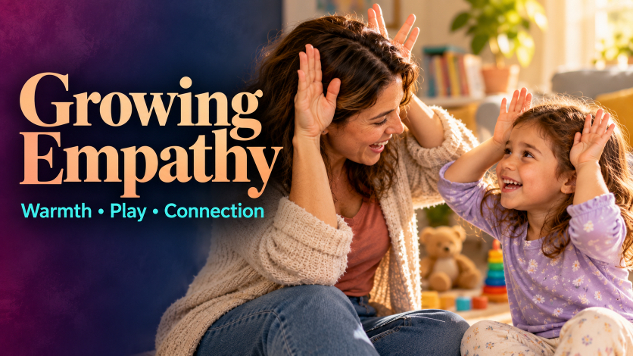
Parents, they suggest, can positively support these aspects of social and emotional development by artificially creating situations, like one in which arbitrary imitation happens, for example.
“Encourage the child to make the silly noise or movement you did, then laugh about it,” Waller says. “You more explicitly scaffold the situation than if it were to happen naturally, but the children still get the positive reinforcement and it can become a bonding moment.”
In regard to fearlessness and social affiliation, Wagner suggests veering away from harshness, toward warmth.
“Changing kids’ experiences,” he says, “that’s where we can intervene.”
About the Study's Authors
Rebecca Waller is an assistant professor in the psychology department at the University of Pennsylvania and director of the EDEN Lab.
Nicholas Wagner is an assistant professor at Boston University and director of the Biobehavioral and Social-Emotional Development Lab.
Further Reading
-
UnSelfie: Why Empathetic Kids Succeed in Our All-About-Me World
Michele Borba explores how children learn to notice other people’s feelings and respond with care. Her suggestions give parents and educators ways to practice kindness, cooperation, and perspective-taking in everyday life.
Amazon: https://www.amazon.com/exec/obidos/ASIN/1501110039/innerselfcom
-
No-Drama Discipline: The Whole-Brain Way to Calm the Chaos and Nurture Your Child's Developing Mind
Daniel J. Siegel and Tina Payne Bryson describe ways to respond to difficult behavior while keeping a close relationship with your child. They explain how to set limits, handle strong emotions, and teach through calm interaction rather than harsh punishment.
Amazon: https://www.amazon.com/exec/obidos/ASIN/034554806X/innerselfcom
-
Playful Parenting: An Exciting New Approach to Raising Children That Will Help You Nurture Close Connections, Solve Behavior Problems, and Encourage Confidence
Psychologist Lawrence J. Cohen shows how joining children in play can help them express feelings and connect with their parents. Shared laughter, games, and playful exchanges offer practical opportunities to work through tension and enjoy being together.
Amazon: https://www.amazon.com/exec/obidos/ASIN/0345442865/innerselfcom
Article Recap
Callous-unemotional traits in children can lead to antisocial behavior, emphasizing the need for positive social interactions and warmth in parenting. Parents should create opportunities for bonding and avoid harsh disciplinary methods.
#InnerSelfcom #CallousUnemotionalTraits #ChildDevelopment #ParentingStrategies #SocialConnection #EmotionalIntelligence