





Share
In This Video
- Nature's Ancient Music
- Songs Across Ocean Basins
- Human Singing Together
- Calls and Their Functions
- Gibbons and Whales
Animals have created structured music long before humans existed, using techniques that mirror elements of human composition. Wood thrushes employ repetition and variation in recognizable sequences, while their pitch intervals resemble those found in musical traditions worldwide. Humpback whales compose songs lasting up to twenty minutes that evolve as whales learn phrases from one another, spreading innovations across ocean basins through cultural transmission.
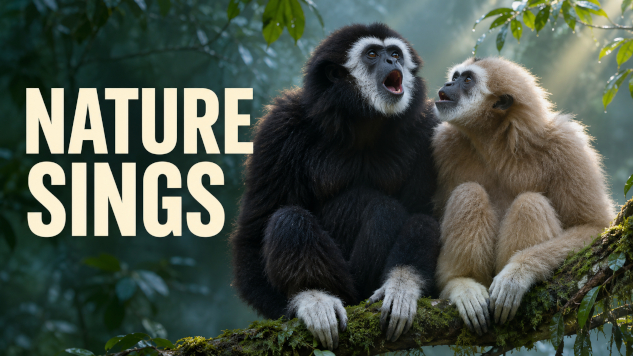
Gibbons perform coordinated duets where partners adjust timing in response to each other, demonstrating how meaningful patterns emerge from synchronized interaction. Rhythm appears consistently across diverse species—from insects and frogs to fish—serving purposes like mate attraction, territorial claims, and social bonding. While animal vocalizations and human music differ in complexity and reach, both share fundamental principles of rhythm, pitch, repetition, and variation that connect us to natural musical traditions spanning millennia.
Transcript
Nature's Ancient Music
Nature was making music long before humans arrived, and the evidence is everywhere once you start listening.
Take the wood thrush. It repeats a phrase, varies it, and builds sequences you can begin to recognize.
If you stay still and listen through several rounds, you may hear a familiar phrase come back with a different ending.
That balance between repetition and surprise is part of what holds our attention in human music, too.
And researchers have found that some birdsong uses pitch intervals that also appear in musical traditions around the world.

Then there are humpback whales. A single song can last up to twenty minutes, and the songs change over time as whales pick up new phrases from one another.
Songs Across Ocean Basins
Those changes can spread across ocean basins. Imagine hearing a phrase in one part of the ocean and later hearing it sung by whales far away.
The song has traveled because other whales heard it, took it up, and passed it along.
That's a form of cultural transmission, and it happens entirely without us.
Gibbons do something different. Partners sing duets, and each adjusts the timing of its calls in response to the other.
Listen to one part by itself and you'd miss what makes the duet remarkable.
So much of the pattern comes from the way the two voices leave room for each other.
Human Singing Together
Anyone who's sung with another person knows the feeling of listening for the moment to come in.
And you don't have to go to a rainforest or out to sea to hear organized sound.
On a summer evening, listen to the insects for a while, and then notice how the frogs draw your attention as their calls begin to line up.
Even some fish make sounds with structured timing.
What strikes you, once you start paying attention, is how often rhythm turns up in animals that have very little else in common.
Of course, these sounds can serve very different purposes.
Calls and Their Functions
A call may attract a mate, announce that a territory is occupied, or help partners stay connected.
From a distance, two songs might sound equally beautiful to us, but to the animals listening, one could be an invitation and the other a warning.
And for a gibbon singing with a partner, the timing of the reply may matter as much as the sound itself.
Human music has taken rhythm, pitch, repetition, and variation in extraordinary directions,
and we've found ways to record them, teach them, and share them with people we'll never meet.
But the next time a song makes you wait for a voice to come back in, or a rhythm makes you want to join in,
Gibbons and Whales
think of the gibbons listening to each other and the whales carrying a phrase across the ocean.
In our own way, we're taking part in something life has been doing for a very long time.
Source article: Did Nature Invent Music Before Humans