




In This Article
- How four influential figures helped transform American capitalism from stakeholder responsibility to shareholder supremacy during the 1970s and 1980s
- The economic philosophies, political strategies, legal theories, and government policies that concentrated wealth and corporate power
- Why consumer products, journalism, music, and creative culture have deteriorated under profit-centered incentives
- The human costs of inequality, insecurity, and the weakening of democratic institutions
- How artificial intelligence could fundamentally alter the relationship between production, employment, and human freedom
There's a SNL sketch from November 2026 that keeps coming back to 1985. The performers are in a muddy field, doing the Woodstock thing and the joke always lands in the same spot. By 1985 the generation that had been all about peace and love had discovered something they loved even more: money.
The sketch works because it gets at something real. The cultural shift in America from a society which at least in theory aspired to shared prosperity to one which measured success almost entirely in terms of financial accumulation didn't happen by accident. It wasn't a natural progression. It was deliberately engineered, actively promoted and institutionalized by people who had very specific ideas about how the world ought to work.
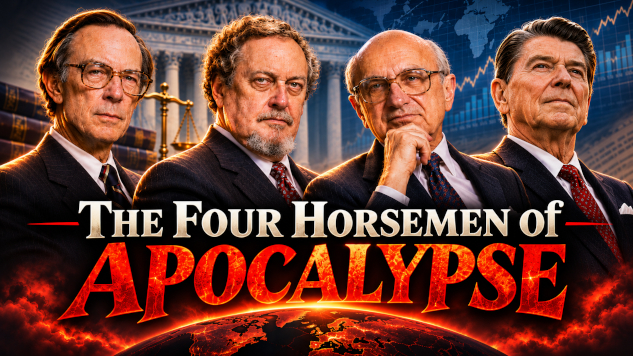
Now to be fair, you can't attribute this entire transformation to four people. History doesn't work that way. But four men did more than most to lay the intellectual groundwork, to build the political structure, to reconfigure the legal structure and to get all of that translated into actual government policy. Milton Friedman in particular gave corporate America the intellectual green light to abandon its wider responsibilities.
Lewis Powell drew up the blueprint for converting economic power into political power. Robert Bork rewrote the rules of corporate concentration. And Reagan took the whole shebang and made it the operating system of the federal government. They didn't just change economic policy. They changed what an economy was supposed to do in the eyes of the American people.
Milton Friedman and the Gospel of Shareholder Supremacy
In Sept '70 the NY Times Magazine ran an essay by economist Milton Friedman entitled 'The Social Responsibility of Business Is to Increase Its Profits'. The argument was simple and elegant. The business executive is an employee of the owners of the business. His job is to make money for the owners, within the rules of the game.
When execs spend company money on social programs, environmental improvements or community initiatives which in themselves don't contribute to profitability they're effectively imposing a tax on the shareholders without their knowledge or consent. If society wants social programs that's the government's remit. That's not what business is for.
It was perfectly reasonable. It was also a bomb thrown into the middle of the postwar economic consensus which had, however imperfectly, come to accept that the corporation had a duty to balance the interests of shareholders, employees, customers and the community. The stakeholder model wasn't perfect. There were plenty of companies out there that had always behaved very badly. But there was at least the expectation that a successful company would do something for the people who worked for it and the communities in which it operated.
Friedman's essay went a long way to shatter that assumption. In the decades that followed shareholder primacy became the prevailing doctrine of American corporate management. Executive pay was increasingly linked to stock performance. The quarterly results were the key measure of a company's health. Any decision which would improve the short term share price was rewarded, regardless of the long term impact on productive capacity.

Imagine a hypothetical manufacturer. The stakeholder model would see it as investing in quality products, paying good wages and building long term customer relationships. The shareholder primacy model sees the same company and says "look, we can make a lot more money by cutting corners on quality, paying lower wages, offshoring the manufacturing, and using the savings to buy back our own shares". The share price goes up. The executives get their bonuses. The product is worse. The workers are worse off. And Wall Street is delighted.
Friedman himself was more circumspect than a great many of his followers. He did say that businesses should be operating within the law and in accordance with accepted ethical standards. The caveat of course was quickly lost on corporate America. What they took away was the rather simple message that the only obligation of a business is to make a profit. Everything else is somebody else's problem. That message was enormously convenient to those who were already in the habit of thinking that way.
Lewis Powell and the Blueprint for Corporate Political Power
On 23 August 1971 a Richmond VA attorney, Lewis Powell, wrote a confidential memo to his neighbor Eugene Sydnor (chairman of the education committee of the US Chamber of Commerce). The memo was entitled' Attack on the American Free Enterprise System' and was essentially a battle plan.
Powell was very concerned. The consumer advocates (Ralph Nader etc) were winning their regulatory battles. The environmentalists were having a real effect and getting new restrictions on industry. The labor movement was still very strong. There were plenty of critics of corporate capitalism on the campuses. In Powell's view the media was very much in favor of the critics. Business in America was under constant attack and was doing absolutely nothing to counter it.
His solution was to go all the way. Business had to get itself organized, properly funded and in a position to run a sustained campaign to influence every institution that in any way shaped the American public. Universities would need business-friendly academics and a business-friendly curriculum. The media would need business funded programming and business pressure on the editorial side. The legal system would need business-friendly litigation. Political campaigns would need the money and they would need a lot of it. Powell wasn't suggesting you win an argument. He was suggesting you build an infrastructure of influence that would go on to change the shape of American society from within.
Two months after writing the memo Powell was nominated to the Supreme Court by Richard Nixon. The memo wasn't known to the public at the time of his confirmation. The ideas in it were however very much in demand and over the ensuing decades an extraordinary network of corporate funded think tanks, policy institutes, media organizations, lobbying outfits and legal foundations came into being.
The Heritage Foundation was founded in 1973. The Cato Institute in 1977. The Federalist Society in 1982. CPA's (corporate political action committees) proliferated. The revolving door between industry and government started to spin so fast it actually ground the hinges to dust.
Did Lewis Powell personally do all of that? No. He simply said something that powerful people wanted to hear, namely that corporate America could and should use its financial muscle to go in and systematically rework the political and intellectual environment. It wasn't a blueprint, it was a green light and corporate America took that green light very much to heart.
There's a very important distinction to be made here. To compete successfully in a market is one thing. To use your accumulated economic power to go in and re-write the rules of that market is quite another. Powell was instrumental in legitimising the second approach as a matter of institutional survival.
Robert Bork and the Neutering of Antitrust Law
For the majority of the 20th century American antitrust law was about much more than just prices. The Sherman Act of 1890, the Clayton Act of 1914 and the traditions of enforcement that grew out of those Acts were all concerned with the dangers of concentrated economic power. A monopoly or a dominant corporation was seen as a threat not just because of the potential for higher prices, but because of the potential for it to stifle competition, exploit labor, squeeze out suppliers and build up political power which in turn would be a threat to the democratic process.
Robert Bork thought all of that was complete nonsense. In his 1978 book "The Antitrust Paradox" he contended that antitrust enforcement had become all confused and in fact counter-productive. The courts were simply protecting the inefficient competitor because it was small, and were punishing the successful competitor for the crime of being good at what they did. The one thing antitrust law should be doing, Bork maintained, was to maximize consumer welfare (and that was primarily in terms of price and economic efficiency).
The argument had a certain force to it. No one wanted to defend inefficiency in the abstract. Bork was quite right to point out that some of the earlier antitrust decisions had been badly reasoned. His framework just had one massive blind spot though: it effectively ignored everything that wasn't a price.
A firm can amass massive market power without in any way raising prices. It can use that power to drive down wages, eliminate the suppliers' ability to negotiate, keep would-be competitors out of the market, reduce the quality of the product, harvest data on individuals and use that data to its advantage, and use its market power to influence the political process in a way that will shape the regulatory environment to its benefit. If the only thing antitrust law looks at is whether prices have gone up then all of that is completely invisible.
Look around you and you can see the results. Four companies process over 80% of the American beef. A small number of technology platforms control a huge amount of the world's digital commerce, digital advertising and the distribution of information. The pharma companies have all merged together until there is effectively no competition left to keep the prices down.
Hospital systems consolidate right down to the point where patients across the whole region have no real choice at all. All the while the Bork-style antitrust regime keeps asking the same absurd question: are prices to consumers lower?
Sometimes they are. A dominant company can actually offer lower prices simply because it has got rid of the competition which would have offered an alternative. That's not a healthy market. That's a trap.
Ronald Reagan and the Transformation of Government Policy
Milton Friedman supplied the economic theory. Lewis Powell supplied the political strategy. Robert Bork supplied the legal theory. Ronald Reagan supplied the presidency.
When Reagan took office in January 1981 the economy was in a genuine state of distress. Inflation was well over 10%. Unemployment was high. Growth had ground to a standstill. The postwar economic consensus was dead and the electorate were very much in the "we're done with this" mood. Reagan came in with the simple message that government was the problem not the answer. Taxes were too high. Regulation was excessive. The market would work if you just let it work.
The policy changes were very rapid. The Economic Recovery Tax Act of 1981 reduced the top marginal income tax rate from 70% to 50%. The Tax Reform Act of 1986 would bring it down still further to 28%. The theory was supply side economics: that by reducing the tax rate on the rich you would stimulate investment, which would lead to jobs and growth, which in the end would benefit all. The benefits would trickle down.
Well they trickled. That's absolutely true. The trickle was tiny.
In August 1981 Reagan fired over 11,000 striking air traffic controllers who had refused to come back to work following his order for them to return. The PATAO was decertified. The message to organized labor was absolutely clear: the federal government was no longer going to be the neutral arbiter between management and the workers. It had picked a side.
Unionization has been on the downhill side since the mid 50s and the decline has accelerated. In 1983 some 20% of US workers were unionized. That's now down to about 10%. The link between the decline in union power and the stagnation of wages is not accidental. If workers can't collectively bargain then they just take what's on offer.
The DOJ's 1982 merger guidelines (which were the product of Reagan appointees) were very much in the Bork consumer welfare mold. Mergers were to be judged primarily on their impact on prices and on economic efficiency rather than on their impact on competition, on workers, on suppliers or on communities. That wave of consolidation which swept through the industry had a profound effect.
Remember that SNL sketch and its obsession with 1985? By that point the whole thing was institutionalized. Tax policy was stacked in favour of the rich. Labor protections were eroding. Concentration of corporate power was accelerating. The financial sector was growing. A whole new generation were being taught that the measure of a successful life was the size of your portfolio. The Woodstock generation hadn't just grown up, they'd been handed a whole new set of values by an economy which rewarded individualism and punished any notion of collective action.
From Creating Value to Extracting Wealth
Here's something most of us have noticed, but very few of us ever talk about with any real precision at all. Things are getting worse. Not everything. Not everywhere. The general trend in American consumer goods, services and institutions has been down for decades and there is a very specific reason for that.
There's a difference between productive economic activity and financial extraction. Productive activity is the creation of something of real value: a durable piece of kit, a useful service, a treatment that actually works, a house that will last. Financial extraction is the pursuit of profit without the creation of any corresponding value. It can even be value destroying.
When exec pay is linked to stock performance then you have executives with a very strong incentive to drive up short term profits in any way they can. Cut quality. Cut customer service. Replace the full time staff with contractors. Outsource manufacturing to the cheapest possible bidder. Add all sorts of hidden fees. Make products that can't be repaired. Move to subscription models where you're charging the customer forever for things they would have bought once. Use buybacks to inflate the share price rather than actually invest in R&D or in employee pay.
Henry Ford worked out a century ago that if you paid your workers enough so that they could afford the products they were making, everybody won. The modern version of that is even simpler: don't pay them more, just give them credit. Then they can't get up and drive off in the cars they've earned. They're stuck.
Look at housing. Look at the appliances that used to last 20 years and now go after just 5. Look at healthcare where the admin costs take up such a massive proportion of every dollar you spend. Look at the software that used to be a one off purchase and now you're paying a monthly fee forever. Look at the airline seats that keep getting smaller. Look at the customer service phone trees that are designed to wear you down until you just give up.
Not every fall in quality is the direct outcome of shareholder primacy. Some are simply the result of competitive pressure or a technological trade-off. The pattern is clear though. When it's easier for a business to increase its profits by extracting more value from the customer than by improving the product itself, the link between profitability and the public good is effectively destroyed. And the system we have in place actively rewards that behavior.
The Attention Economy and the Decline of Craftsmanship
The same incentive structure which has so badly degraded the consumer product has done exactly the same thing to journalism, music, TV and digital media. If the primary objective is to capture attention then quality is the first thing to go.
Think about music. The qualities we associate with a good, lasting song aren't in any way mysterious. It's a memorable melody. It's a harmonic progression that takes you on an emotional journey. It's lyrics that say something you can actually hear and appreciate. It's performers who have really got their craft. It's an emotional truth that links the artist's experience to the listener's. All of that takes skill, effort, time and in many cases money that the market simply won't always supply.
Contemporary music production has increasingly replaced musical substance with digital effects, visual spectacle, artist branding and social media. That doesn't mean technology is in any way bad for music. A synth is a tool just as much as a guitar. The difference is between using technology to realize a creative vision and using it to produce a product that is commercially viable through the use of spectacle rather than substance.
The same applies to journalism. Ad-supported media platforms are incentivized to get attention, clicks, time spent and engagement. Sensationalism gets more clicks than analysis. Controversy gets more engagement than nuance. Headlines that provoke an emotional reaction get more readers than those that are accurate. The incentive structure is therefore absolutely geared towards content which grabs your attention rather than content which is actually going to inform your judgement.
We're inundated with content designed to provoke an emotional reaction rather than provide useful information. The gap between what an informed citizenry actually needs and what a media system funded by advertising provides is a massive one. That gap has real consequences for democracy, for public health and for our capacity as a society to deal with the range of problems that require accurate information and a degree of thought.
The Hidden Cost of Profit on Human Creativity
Somewhere at this very second there's a chap sitting at a kitchen table with a song in his head that could change someone's life. He'll never record it. He can't afford to be out of work, can't afford to go out and hire musicians, can't afford to book a studio. The song will die and no-one will ever know what's been lost.
This isn't a sentimental observation at all, it's an economic one. When creative activity has to constantly justify itself in terms of commercial return then vast quantities of human potential go unfulfilled. The record company, the publisher, the film studio, the commercial broadcaster are all gatekeepers whose first consideration is risk management. They will go with the formula, the sequel, the predictable, the thing that's been done before. Originality is risky and risk is expensive and expense is a direct reduction in return.
The difference between artistic value and commercial value is very real and very significant. A song which is only heard by a few hundred people can have a profound impact on the lives of those who hear it, can change the way they perceive their own lives, can give them the strength to go through a tough time. That song will have generated absolutely nothing in the way of revenue. A very commercially successful piece of work may entertain millions and achieve absolutely nothing in terms of lasting value. The market doesn't make that distinction at all. It's all about the dollars.
Throughout human history the most lasting creative works have been driven by curiosity, beauty, personal expression, spiritual yearning and social awareness rather than by the desire for profit. The economic system we have created has systematically devalued those motivations. Financial insecurity will always limit the amount of time and money you can devote to experimentation. The commercial gatekeepers will always filter out the work that they can't sell. The end result is a culture that is commercially efficient and artistically bankrupt.
But something is shifting. AI assisted creative tools are now enabling a massive reduction in production costs. The independent artist can now write their own original lyrics, produce professional quality music via AI tools and create the accompanying videos all without the need for the traditional recording industry backing. The gatekeepers have lost their stranglehold on production capability. That in itself doesn't necessarily lead to great art but it does remove one of the biggest barriers to art being created.
The Human Cost of Concentrated Wealth and Chronic Insecurity
In 1980 one per cent of the population held about 20 per cent of the wealth in the country. By today's figures that one per cent holds some 40 per cent. The numbers tell a story, and the story is more than just a set of numbers.
It's about the family who can't afford a medical emergency. The young couple who will never own a home. The worker who has three part-time jobs because full-time employment with benefits has effectively become a luxury. The parent who would rather be reading to their child than going into work and can't afford to cut their hours. The retiree who has to choose between medication and groceries.
Chronic financial insecurity doesn't just limit your ability to buy things. It limits your freedom. It limits your ability to take risks, to change jobs, to start a business, to go to university, to get involved in the community, to just live your life with some degree of dignity. It creates anxiety which has a direct impact on your physical health, your mental health, your relationships and your communities. It also creates a political environment in which a population that is fearful and insecure is easily susceptible to demagogues who offer simple answers and convenient scapegoats.
Concentrated media ownership and the structure of social media all work together to exacerbate the problem. If a small number of companies control the majority of the information that people are exposed to, and if those platforms are designed to maximize engagement rather than accuracy, then misinformation will spread much more quickly than the truth will. That leads to increased polarization and a decline in trust in institutions. Foreign adversaries who want to do America harm don't even need to create the divisions. They can simply take advantage of the ones that are already there.
This is by no means inevitable. The Nordic social democracies are the textbook example of a prosperous market economy which can have private enterprise alongside extensive public services, strong worker protections and a very high degree of economic security. Finland, Denmark, Norway and Sweden are consistently among the happiest, healthiest and most innovative societies in the world. They have private companies, private enterprise and competitive markets. They also have universal healthcare, free education, a very strong safety net and unions which represent a very significant proportion of the workforce.
The basic income experiments in Finland, Kenya and the US have all found that unconditional income doesn't make people lazy. It makes them healthier, less anxious, more likely to go on and invest in education and more inclined to take productive risks. The idea that people will just stop working if they have economic security is not borne out by the evidence at all. What people do stop doing is suffering.
Artificial Intelligence and the Coming Transformation
Everything I've described up to this point has been about the past and the present. Let's now talk about what's coming.
AI is driving down the cost of producing information, software, writing, visual art, music, design, legal analysis, medical diagnosis and pretty much all other forms of intellectual output. The cost reductions are not incremental. They are massive. What used to require a team of specialists can now be done by a single individual with the right tools, or indeed by no individual at all.
Robotics and physical automation are delivering similar productivity gains into manufacturing, transport, agriculture, construction and logistics. We're approaching a world in which ever fewer human labor hours are needed to produce ever greater quantities of goods and services.
The development of open-weight AI (workings of which have been significantly advanced by Chinese researchers) has seriously eroded the ability of any one company or government to maintain a monopoly on advanced AI. That's massively important. If AI stays a proprietary technology in the hands of a small number of companies then it's just another tool for the concentration of wealth and power. If it's open then it becomes something else altogether: it becomes a tool for the democratization of productive capacity.
Open-weight technology doesn't get rid of the cost of computing, of electricity, of infrastructure and of physical resources. It doesn't make everything free. What it does is dramatically lower the barrier to entry. A small business, an independent creator, a community group or indeed an individual in a developing country can now access capabilities that would have been out of reach of them previously.
Here's the economic contradiction that no one in power wants to talk about. If AI and automation can produce all of the stuff the society needs with a fraction of the human labor, yet households are still reliant on employment income to buy the output of the economy, then we have a system which is becoming incredibly productive and yet utterly incapable of distributing that output to the people who need it. We can produce more than we ever have before and far fewer people can afford to buy it.
This paradox has a resolution, though the resolution requires us to think about money in a very different way. Money is not a natural resource. It is a man-made instrument. A government which issues its own currency is not in the same financial straitjacket as a household. It can create money.
The real constraints are physical: land, energy, materials, infrastructure, ecological limits and productive capacity. Inflation is a real issue when you're spending beyond real productive capacity. The idea that money creation must always be via interest-bearing private debt is a policy choice, not a law of nature.
An AI dividend (a form of universal basic income funded by the productivity of AI) would be a distribution of purchasing power which is entirely independent of paid employment. It wouldn't be charity. It wouldn't be welfare. It would be the recognition that when machines do the work, the benefits of that work should go to everyone rather than just to the people who own the machines.
Beyond the Four Horsemen
For decades the economic ideas of Friedman, Powell, Bork and Reagan have taught us to measure success in terms of profit, growth and financial return. Those are the metrics of how much money you're making. They don't tell you whether people are actually living well.
What if AI and robotics did the bulk of the production that society needs and an appropriately structured social dividend provided people with enough purchasing power to meet their basic needs? What if people didn't have to spend the majority of their waking hours in jobs that were essentially just for the sake of survival?
The classic fear is that people will just become lazy, pointless and unproductive. The evidence seems to be the complete opposite. Once people have economic security they don't stop working. They start to work on things that matter to them. They go on to make music, write stories, teach children, look after their elderly parents, start community gardens, coach sports, volunteer at shelters, follow their scientific curiosity, build things with their hands and spend time on the relationships that are important to them.
Human creativity predates financial markets by a long way and has never needed a profit motive. The people who painted in Lascaux weren't thinking about their Q4 results. The medieval builders of the cathedrals labored for decades on things they would never actually see finished. People write poetry that will never be published, play music that will never be recorded and look after their neighbors even though they will never be paid to do so. The desire to create, to contribute and to connect is not an economic imperative. It's a human thing.
AI assisted creative tools in conjunction with economic security could enable something truly unprecedented. A person with no formal musical training at all could write music. A person with a wealth of life experience but who has no real writing ability could produce a work of literature. A small community could make a film, record its own history and traditions and share them with the world. The gatekeepers who have always had the power to decide what gets made and what gets buried would be out of their power and the full spectrum of human creativity would start to emerge.
This by no means implies that material scarcity would vanish. Physical resources are still finite. There are still ecological limits. Technological abundance doesn't necessarily lead to wisdom, compassion or artistic merit. There would still be bad music, bad writing and bad ideas (probably more of them than ever). The opportunity to create, to explore, to express what it is to be human would simply no longer be constrained by economic circumstance.
Go back to that filthy field at Woodstock in '69. Half a million people gathered around an idea that life could be about something other than accumulation, competition and the relentless pursuit of financial security. They were young, they were idealistic and they had no real inkling of the economic forces that would be at work over the next 50 years systematically eroding the very conditions which might have made their vision possible.
The irony is that AI could make those aspirations far more economically viable than they were in 1969. Not because of some magic of technology, but because technology is now approaching the point at which it can deliver material abundance without the need for every individual to sell their labor in order to survive.
The question isn't whether we can build such a world. The question is whether we will. Will we choose to? Or will we simply allow the same concentration of wealth and power that the four horsemen helped to create to take the benefits of AI for the few and leave the many to fend for themselves as best they can?
We have been down the trickle-down road. We know where it leads. The greatest achievement of an advanced economy is not how much wealth it accumulates, how many hours people work, or how much profit corporations generate. It is how much freedom that economy gives people to live, create, learn, love, and contribute to the well-being of others. We have the tools to build that economy. The only thing standing in the way is a set of ideas that four men helped make powerful, and that the rest of us have the power to outgrow.
Recommended Books
The Antitrust Paradox by Robert Bork — A foundational text arguing that antitrust enforcement should focus narrowly on consumer welfare and economic efficiency rather than the broader social and political consequences of corporate concentration.
The Shock Doctrine by Naomi Klein — An investigation of how economic crises have been exploited to implement free-market policies that concentrate wealth and power while dismantling public institutions and social protections.
Utopia for Realists by Rutger Bregman — A compelling case for universal basic income, shorter working hours, and open borders, drawing on historical evidence and economic research to envision a more equitable and human-centered economic future.
Article Recap
The transformation of American capitalism through the influence of Milton Friedman, Lewis Powell, Robert Bork, and Ronald Reagan created an economic system that prioritized shareholder wealth and corporate power over broader human well-being and creative freedom. As artificial intelligence dramatically reduces the cost of production across nearly every sector, the possibility of distributing economic security through an AI dividend could free people from dependence on paid employment and unleash unprecedented human creativity. Understanding how concentrated wealth and profit-centered economics reshaped American society is essential to building an alternative future in which technological abundance serves everyone rather than enriching only those who own the machines.
#FourHorsemen #ShareholderPrimacy #CorporatePower #EconomicInequality #AIandSociety #UniversalBasicIncome #AntitrustReform #AmericanCapitalism #HumanCreativity #EconomicJustice